Two rolls of packing tape can look identical on the shelf, print the same logo, and cost within pennies of each other, then behave completely differently the moment a box hits a cold trailer or sits in a warehouse for six months. The difference is almost never the film you can see. It is the adhesive underneath it. Most buyers obsess over the carrier, BOPP versus paper, and treat the glue as an afterthought, which is exactly backwards. The adhesive decides whether your seal holds.
Carton-sealing tape uses one of three adhesive chemistries: acrylic, hot melt, or natural rubber. Each has a temperature window where it performs and falls off outside it, so the environment your boxes travel through does most of the choosing for you.
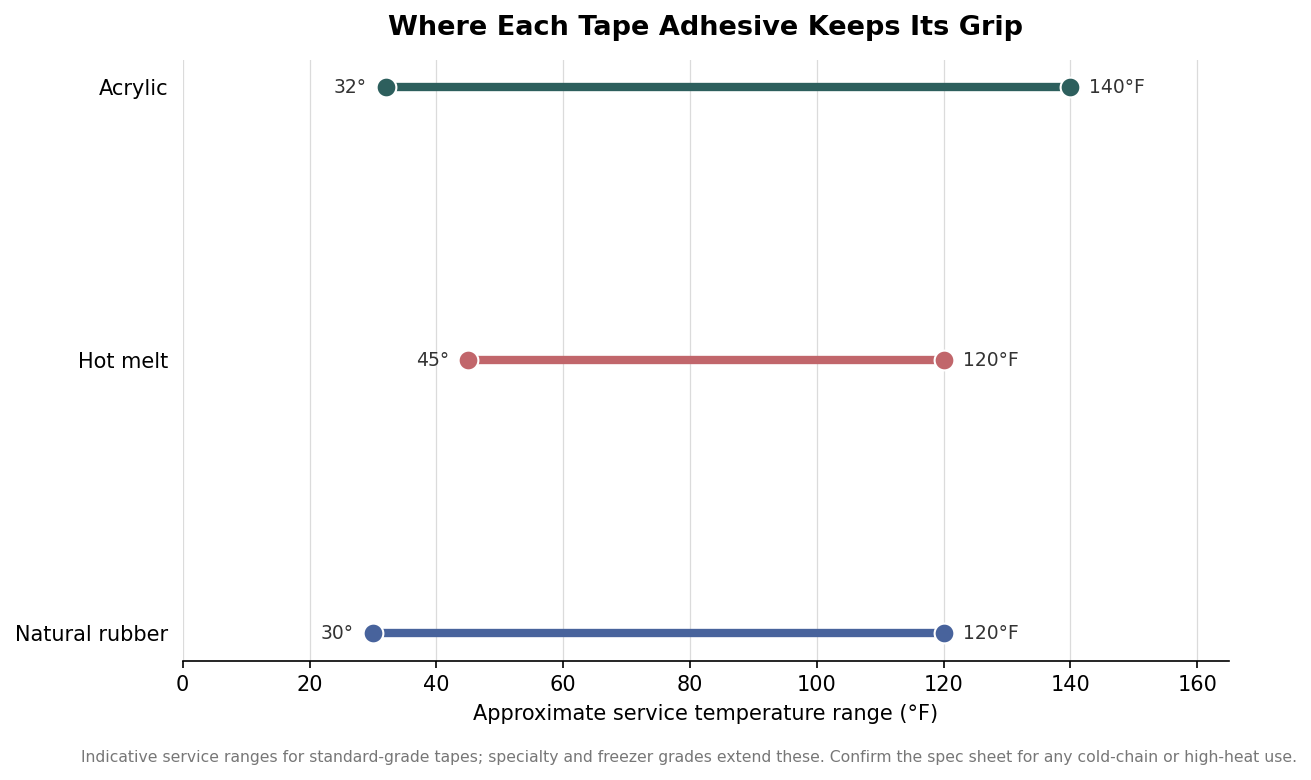
Read that chart as the envelope each adhesive works inside. Acrylic holds its grip across the widest span, roughly 32°F to 140°F for standard grades, which is why it survives sun-baked trailers and refrigerated docks alike. Hot melt runs a narrower band, around 45°F to 120°F, and natural rubber grabs hardest in the cold but gives up the most at the high end. These are indicative ranges for everyday grades; freezer and high-heat specialty tapes push the limits further.
Acrylic: the long-haul default
Acrylic is the tape to reach for when time and sunlight are the enemy. Its defining trait is stability: it resists UV light, oxidation, humidity, and dust, and it does not yellow the way other adhesives do as they age. A box sealed with acrylic and stored for months looks and holds the same as the day it shipped, and its shelf life on the roll is the longest of the three. The catch is initial tack. Acrylic grabs more gently on contact and builds its bond over the hours after application, so it can feel underwhelming on the packing line even though it ends up perfectly secure. For long-term storage, UV-exposed shipments, and anything moving through swings between hot and cold, acrylic is the safe default, and it is usually the most economical of the three per roll.
Hot melt: grip now, especially on recycled board
Hot melt trades some longevity for immediate, aggressive holding power. Its shear value and tensile strength are higher than acrylic’s, and it tacks instantly, which is why high-throughput operations and automatic case sealers standardize on it. That quick grab matters most on difficult surfaces. Boxes with high recycled content have dustier, less uniform faces than virgin kraft, and hot melt bites into them where a gentler adhesive would lift at the corners. It also handles overstuffed and slightly irregular cartons well because it stretches under stress without releasing. The downside is aging: hot melt can yellow over time and has a shorter shelf life, and its narrower temperature window means it is not the tape for a cold-chain shipment or a pallet parked in the sun for a season. For fast-moving fulfillment on recycled boxes, though, nothing seals more confidently out of the gate.
Natural rubber: maximum grab for the hard cases
Natural rubber is the specialist you call when a surface refuses to cooperate. It offers the most aggressive initial tack of the three and performs well at low temperatures, so it clings to cold, dusty, or heavily recycled surfaces that defeat other adhesives. That grabbing power comes at a real cost in durability: natural rubber has the poorest resistance to UV, heat, and aging, tends to yellow, and can carry a noticeable odor. It is also frequently the priciest option. You would not spec it for routine e-commerce cartons, but for a specific problem, sealing recovered or contaminated boxes, or a job where nothing else will stay stuck, it earns its place. Treat it as a tool for edge cases rather than a daily driver.
Reading the trade-off
Line the three up and a clear pattern emerges. The adhesives that grab hardest on contact are the ones that age worst, and the one that ages best grabs most gently. There is no chemistry that wins on both, so choosing well means deciding which failure you can least afford: a box that lifts at the seam on the line, or a box that yellows and loosens after a season in storage.
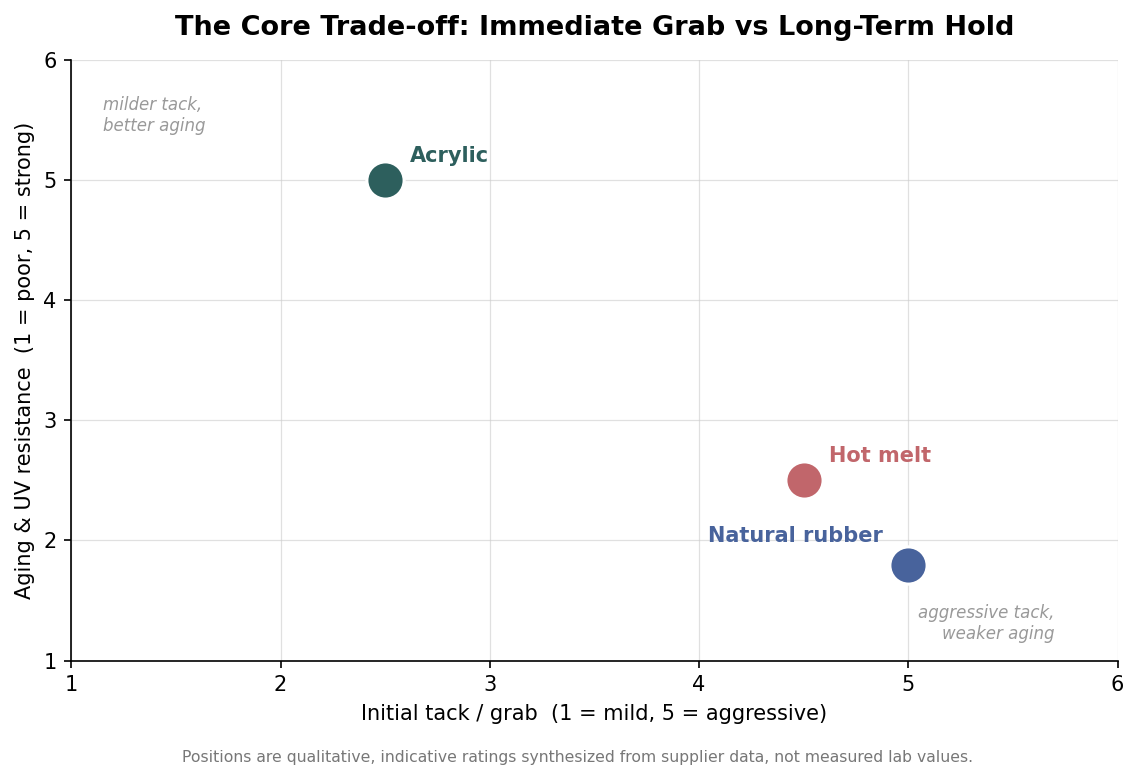
The map makes the tension concrete. Acrylic sits high on longevity and low on grab; natural rubber sits at the opposite corner; hot melt lands in between, closer to the aggressive end. Where your operation belongs on that map depends entirely on what happens to the box after it leaves you. A gift that ships today and is opened Thursday never tests aging resistance. A spare part that sits in a bin for two years never benefits from quick tack. Match the adhesive to the box’s actual life, not to which spec sheet sounds strongest.
How to actually choose
Start with two facts about your shipments: the temperature range they pass through, and how long the seal has to survive. Cold, dusty, or recycled surfaces and immediate handling point toward hot melt, or natural rubber for the genuinely stubborn cases. Long storage, temperature swings, or sun exposure point toward acrylic. Then confirm the carrier and thickness separately, since a good adhesive on an underweight film still fails; standard carton tapes commonly run around 1.6 to 2.0 mil, with heavier grades for demanding loads. If you print a custom design on the tape, remember that the print sits on the film and does not change the adhesive underneath, so you get branding and the right chemistry at the same time rather than trading one for the other. When a shipment is high-value or headed somewhere extreme, order a roll of your leading candidate and test it on your real boxes in your real conditions before committing to a full run. The numbers here are solid starting points, but your cartons and your climate are the final word.
Leave a Reply