Category: Uncategorized

  • Recyclable Custom Packing Tape: What Actually Stays in the Paper Stream

    Recyclable Custom Packing Tape: What Actually Stays in the Paper Stream

    “Recyclable” is one of the easiest words to print on a roll of tape and one of the hardest to actually earn. The question that matters is not whether a strip of tape can theoretically be recycled in isolation, but whether the sealed carton it is holding together still moves cleanly through a paper mill. Corrugated boxes are one of the most-recovered materials in the waste stream, so the tape is usually the weak link. Get the tape wrong and you can turn a highly recyclable box into a contaminated one; get it right and the whole package stays in the loop.

    What recycling actually rewards

    Corrugated cardboard is recovered at a remarkably high rate. According to the EPA’s most recent product-specific figures, corrugated boxes were recycled at 96.5 percent, and paper and paperboard packaging overall at 80.9 percent—far above glass at 31.3 percent or plastic packaging at 13.6 percent. That gap is the whole reason tape choice matters. When you ship in a corrugated box, you are attaching your branding to a material with an excellent chance of being recovered, so the sensible goal is to avoid dragging it down.

    Paper mills recover cardboard by repulping it: the box is slurried in water, the fibers separate, and contaminants are screened out. Anything that dissolves or breaks apart in that bath passes through cleanly. Anything that stays intact and sticky—synthetic adhesive, plastic film—becomes what mills call “stickies,” gummy deposits that foul equipment and show up as defects in the finished recycled paper. So the real test of a recyclable tape is simple: what happens to it in the pulper.
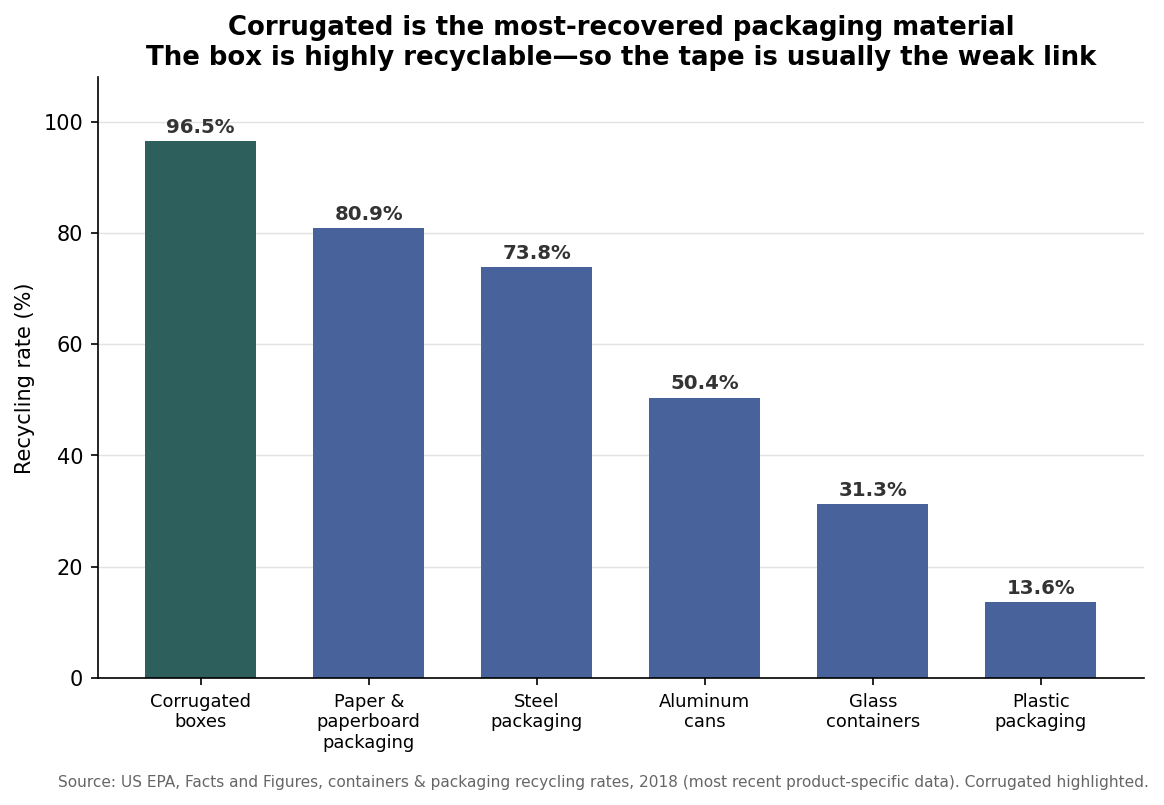
    Bar chart of EPA recycling rates by packaging material with corrugated boxes highest at 96.5 percent
    EPA 2018 data: corrugated is the most-recovered packaging material, so the tape is usually the limiting factor.

    Water-activated paper tape: the repulpable answer

    Water-activated tape, also called gummed kraft or WAT, is the option that genuinely repulps. It is a kraft paper backing coated with a starch or dextrin adhesive—commonly potato or corn starch—that is inert until moistened. A dispenser wets the adhesive, which then bonds into the surface fibers of the carton and, as suppliers put it, “becomes one with the box.” Because the adhesive is water-soluble, it dissolves during repulping and releases the paper fiber cleanly, which is why non-reinforced gummed paper tape can go straight into the cardboard stream without anyone peeling it off.

    The practical trade-off is equipment and technique. WAT needs a water-activation dispenser rather than a handheld gun, and it is a commit-once seal—you cannot reposition it. In exchange you typically get a stronger bond that resists being popped open, and often a single center strip does what two or three strips of plastic tape would. For a brand that wants its packaging to look considered and to survive the recycling claim, custom-printed gummed tape is the cleanest fit, since kraft WAT takes flexographic printing well.

    Where self-adhesive and plastic tapes land

    Pressure-sensitive tapes are the convenient default, and they sit lower on the recyclability ladder. Self-adhesive kraft paper tape uses a hot-melt or acrylic adhesive that stays tacky at room temperature, so it applies from an ordinary dispenser with no water. The paper backing itself is still curbside-friendly, and because the adhesive is generally under 10 percent of the tape’s weight, a box sealed with it is usually accepted—but that adhesive does not repulp, so it adds to the stickie load rather than disappearing. It is a reasonable middle ground when a water dispenser is not practical.

    Plastic BOPP tape is the one to be careful about. It is inexpensive and strong, but the film does not penetrate the fibers and does not break down in the pulper, so it behaves as a contaminant and carries a microplastics concern as it fragments. Boxes sealed with plastic tape are still commonly recycled because mills screen the film out, but you are relying on that screening rather than helping it. If the recyclability of the finished package is part of your brand promise, plastic tape undercuts the message even when the box gets through.
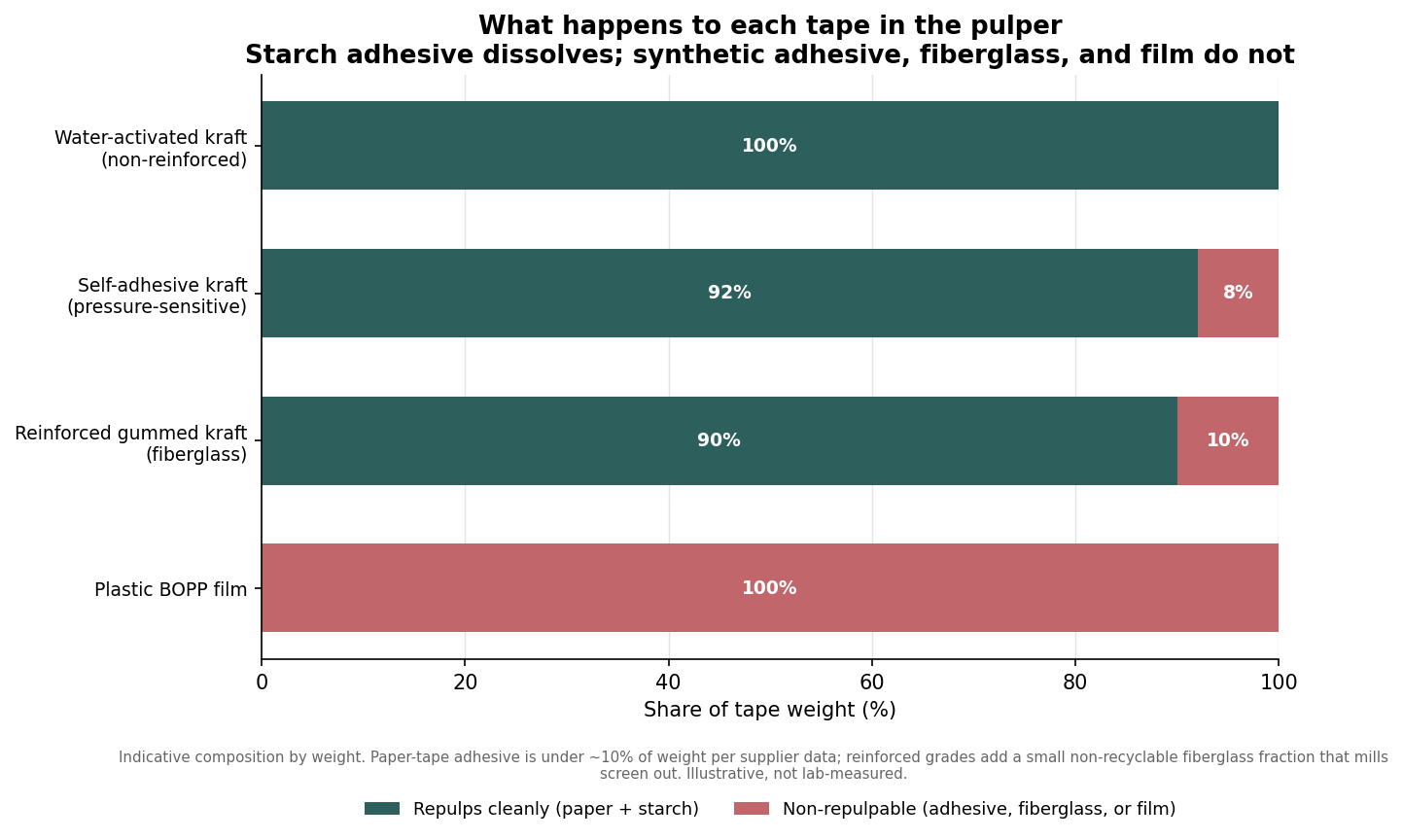
    Stacked bar chart showing the repulpable versus non-repulpable share by weight for four packing tape types
    Only starch-based water-activated tape repulps completely; synthetic adhesive, fiberglass, and plastic film do not.

    The fiberglass trap in “reinforced” tape

    Reinforced tape deserves a specific warning, because it is easy to order by accident. Reinforced water-activated tape embeds fiberglass filaments for extra strength on heavy cartons. The good news is that the paper and starch still repulp normally and mills screen the fiberglass out; the catch is that the fiberglass strands themselves are not recyclable and end up as inert waste. So a reinforced gummed tape is far better than plastic, but it is not the “100 percent repulpable” story that plain gummed tape can honestly claim. If your loads do not truly need the reinforcement, non-reinforced WAT keeps the claim clean. Match the reinforcement to the actual box weight rather than buying it as a default.

    How to specify tape you can honestly call recyclable

    Start from the claim you want to make and work backward. If you want to say a customer can toss the whole box in the recycling without peeling anything, specify non-reinforced water-activated kraft tape with a starch-based adhesive, and confirm you have or will buy a wetting dispenser. If you are staying with pressure-sensitive tape for speed, choose a paper backing over plastic so the box remains accepted, and be honest in your copy—say the box is recyclable rather than implying the tape vanishes. Avoid reinforced grades unless the carton weight demands them, and if it does, describe the tape as recyclable paper with a non-recyclable reinforcement rather than overstating it.

    For branding, remember that the recyclable options are fully printable. Custom kraft WAT prints cleanly in one or two flexographic colors, which is usually plenty for a logo and a short message, and the matte kraft look reads as deliberate and sustainable rather than glossy and disposable. Put the material choice, the print colors, the roll width, and the intended recyclability claim on a single spec sheet, and both your packer and your marketing copy will be working from the same truth.
  • Packing Tape Thickness and Width: How to Spec a Roll That Holds

    Packing Tape Thickness and Width: How to Spec a Roll That Holds

    Two numbers decide whether a sealed box survives the trip: how thick the tape film is, measured in mils, and how wide the roll is, measured in inches. Everything else on a tape spec sheet, from the printed artwork to the adhesive chemistry, sits on top of those two choices. Get them wrong and the seam pops in a trailer or on a doorstep. Get them right and a plain two-strip seal holds through a full parcel network. This walkthrough shows how to pick both figures against the boxes you actually ship, then how to write the spec so a supplier quotes the right product the first time.

    Start with the packed weight, not the box

    Tape thickness is the single spec most buyers underestimate. A mil is one one-thousandth of an inch, and carton-sealing tape generally runs from about 1.6 mil at the economy end to 3 mil and up for the heaviest loads. The film thickness matters because it carries the tension when a loaded box flexes; a thin film stretches and peels at the corners, while a thicker film resists that pull. The deciding input is the packed weight of the box, not its footprint. A small carton full of hardware can outweigh a large carton of foam, and it needs the sturdier tape.

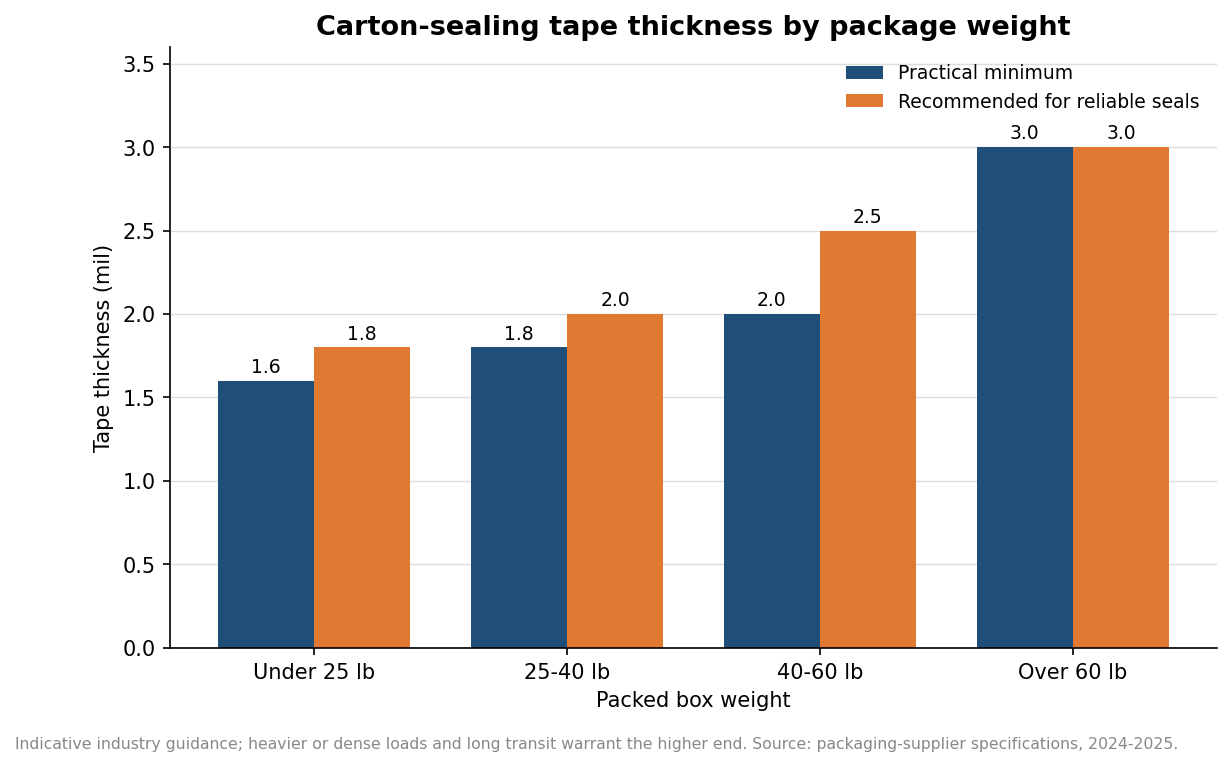
    As a working guide, boxes under roughly 25 pounds seal reliably with 1.6 to 1.8 mil tape, the range most light parcel and retail shipments fall into. Once a packed box passes 25 pounds you want 2.0 mil or a little more, and dense or awkward loads above 40 pounds are better served by 2.5 mil. Past about 60 pounds, 3 mil is the sensible floor, and many shippers pair it with reinforced or water-activated tape rather than standard film. These are indicative bands, not hard cutoffs: long transit legs, humid warehouses, and boxes that get restacked several times all push you toward the higher end of each range.

    Grouped bar chart of recommended carton-sealing tape thickness in mils by packed box weight band
    Match tape thickness to the packed weight of the box; the ranges shown are indicative starting points.

    Width: when two inches is plenty and when it isn’t

    Roll width is the second lever, and here the common sizes are genuinely standard. Two inches, which suppliers often list as 48 millimeters, is the default for the majority of parcels, and it seals the center seam of most small and medium cartons in a single pass. Three inches, listed as 72 millimeters, covers a wider span of the flap gap and grips more surface, which matters on heavy boxes, on cartons whose flaps do not meet cleanly, and anywhere you are relying on a single strip rather than several. The wider tape costs more per foot but can let you seal a box in fewer passes, so the real comparison is total tape laid down, not the price of one roll.

    Most shippers do not need to choose one width forever. A practical setup keeps 2 inch tape for everyday parcels and a 3 inch roll for the heavy or oversized cartons that show up less often. If you are standardizing on a single width to simplify buying, 2 inch handles the broadest range of typical e-commerce and retail boxes, and you compensate on heavier cartons by adding strips rather than switching rolls.

    Why thicker tape costs more, and where the money goes

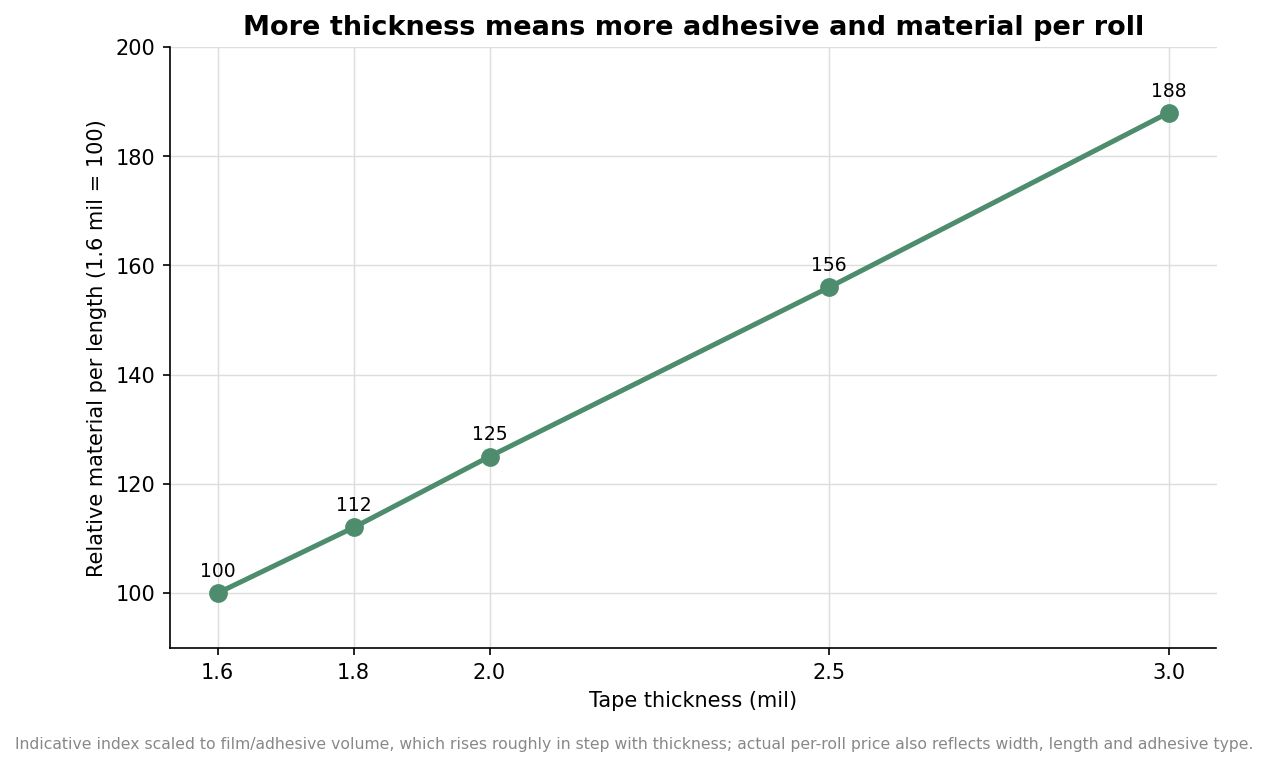
    Thickness is not free, and it helps to see why before you default to the heaviest option. Most of a tape’s thickness is the backing film plus the adhesive coat, and both scale roughly with the mil rating. Moving from 1.6 mil to 3 mil nearly doubles the material laid down per unit of length, and the per-roll price tends to track that. Buying more thickness than the box needs quietly inflates your cost of goods on every shipment, while buying too little shows up as damage claims and reships that cost far more than the tape ever saved.

    Line chart showing relative tape material per length rising with mil thickness from 1.6 to 3.0 mil
    Adhesive and film volume climb roughly in step with thickness, so over-speccing quietly raises per-shipment cost.

    The index above is indicative rather than a price quote: actual cost also swings with roll width, roll length, adhesive type, and print coverage. The point is directional. Matching thickness to weight, rather than over-speccing to feel safe, is where a high-volume shipper finds real savings without trading away seal reliability.

    Adhesive and temperature interact with thickness

    Thickness sets the ceiling on strength, but the adhesive decides whether you reach it. The two workhorse chemistries are acrylic, which is water or solvent based and holds up well across a wide temperature and humidity range, and hot melt, which grabs fast and delivers a firmer initial bond but can soften in real heat. A 2 mil hot melt tape and a 2 mil acrylic tape are not interchangeable in a hot trailer or a freezer program, so the application environment belongs on the spec sheet next to the thickness. Cold surfaces below roughly 45 degrees Fahrenheit are the classic failure point, because adhesive that cannot flow into the cardboard fibers never really sticks. If your boxes are taped in an unheated space or shipped cold, say so up front and let the supplier match a low-temperature adhesive rather than discovering the gap after a batch fails.

    Surface matters too. Recycled and heavily printed corrugate can be dusty or coated, both of which fight adhesion, and a slightly thicker tape with a more aggressive adhesive buys back some of that lost grip. None of this replaces good technique: pressing the tape down along its full length, and using an H-pattern that seals the center seam and both end seams on heavier boxes, does more for reliability than one extra half-mil of film.

    Write the spec so the quote comes back right

    When you hand a supplier a request, five lines remove almost all of the back-and-forth. State the thickness in mils tied to your typical packed weight, the width in inches or millimeters, the roll length you want, the adhesive type and any temperature exposure, and the print requirement if the tape is branded. A line such as “2.5 mil, 3 inch by 110 yard, acrylic, one-color print, boxes average 45 pounds and ship year round in unconditioned trucks” tells a quoting team everything they need and produces a comparable price instead of a guess.

    Roll length is worth a deliberate choice rather than an afterthought. Hand rolls commonly run in the range of 55 to 110 yards, while machine rolls for tape guns and case sealers run far longer, often several hundred yards, to cut changeover time on a line. Longer rolls lower the price per foot and reduce downtime, but only pay off if your volume turns them over before the adhesive ages. Buy the length that matches your throughput, pair it with the thickness your boxes actually demand, and the seam stops being something you think about.

  • Five Packing Tape Mistakes That Make Boxes Burst Open (and How to Spec Around Them)

    Five Packing Tape Mistakes That Make Boxes Burst Open (and How to Spec Around Them)

    A failed tape seal is one of the cheapest problems to cause and one of the most expensive to clean up. A carton that pops open in transit means a damaged product, a refund, and a customer who now associates your brand with a box that arrived taped shut with someone else’s tape. Most of these failures do not come from bad tape. They come from the wrong tape used the wrong way: a thickness that does not match the load, an adhesive that quits in the cold, a seam that was never reinforced, or a bond that never fully formed. Here are the five mistakes that cause branded packing tape to let go, and how to specify around each one so the tape holds and your logo stays on the box.

    Mistake 1: Choosing thickness by feel instead of by box weight

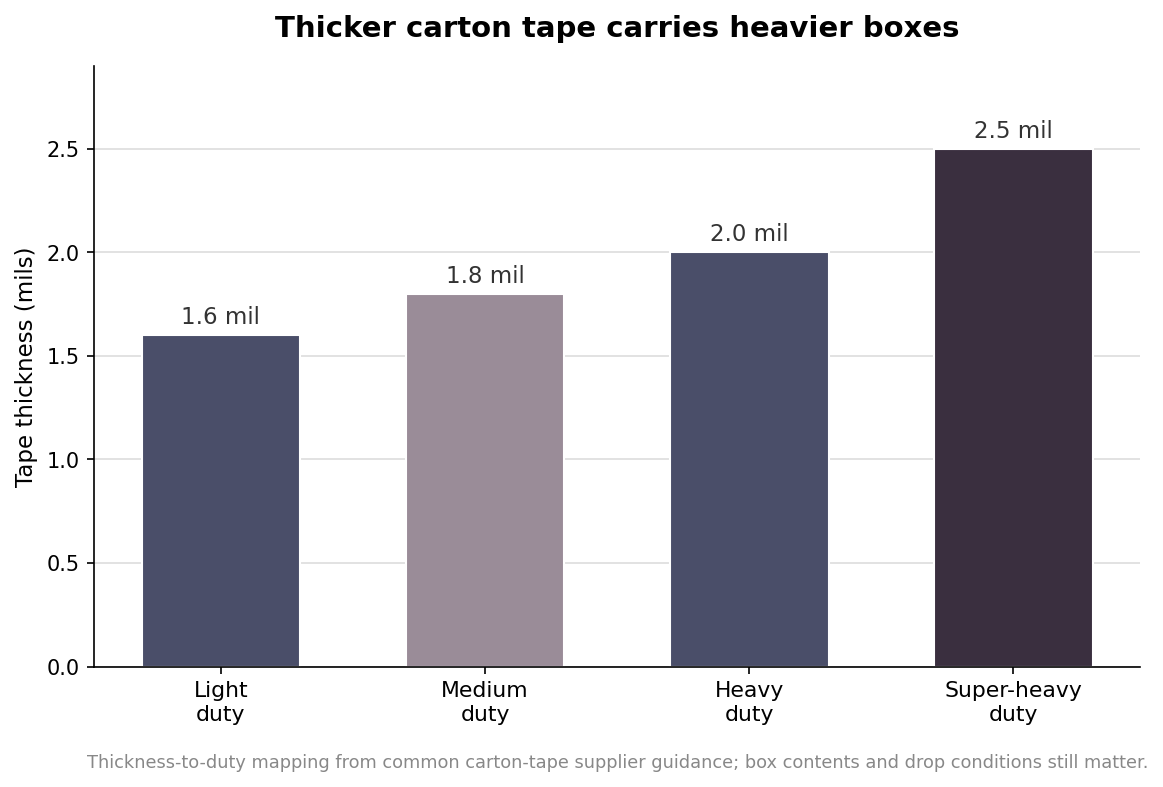
    Carton sealing tape is graded by thickness in mils, where one mil is a thousandth of an inch measured with a micrometer. The number is a decent proxy for how much adhesive and backing you are getting. As a rough industry mapping, 1.6 mil is a light-duty tape for small parcels and low-weight boxes, 1.8 mil handles medium-duty everyday cartons, 2.0 mil is heavy-duty, and anything above that is super-heavy-duty for dense or oversized loads. Some suppliers now offer half-step options like 1.7 and 2.1 mil for buyers who want to fine-tune cost against holding power. Because thicker tape carries more adhesive, it generally holds better, but paying for 2.5 mil to seal a two-pound apparel mailer is money spent on nothing. The mistake runs both ways: under-spec and boxes burst, over-spec and your cost per carton creeps up across thousands of shipments. Match the mil to the heaviest box the roll will actually seal, not the lightest, and remember that a box packed to the brim behaves like a heavier box than its empty weight suggests.

    Bar chart of carton sealing tape mil thickness from 1.6 to 2.5 mapped to light through super-heavy duty
    Tape mil thickness graded from light-duty 1.6 mil to super-heavy 2.5 mil.

    Mistake 2: Running hot melt tape into the cold

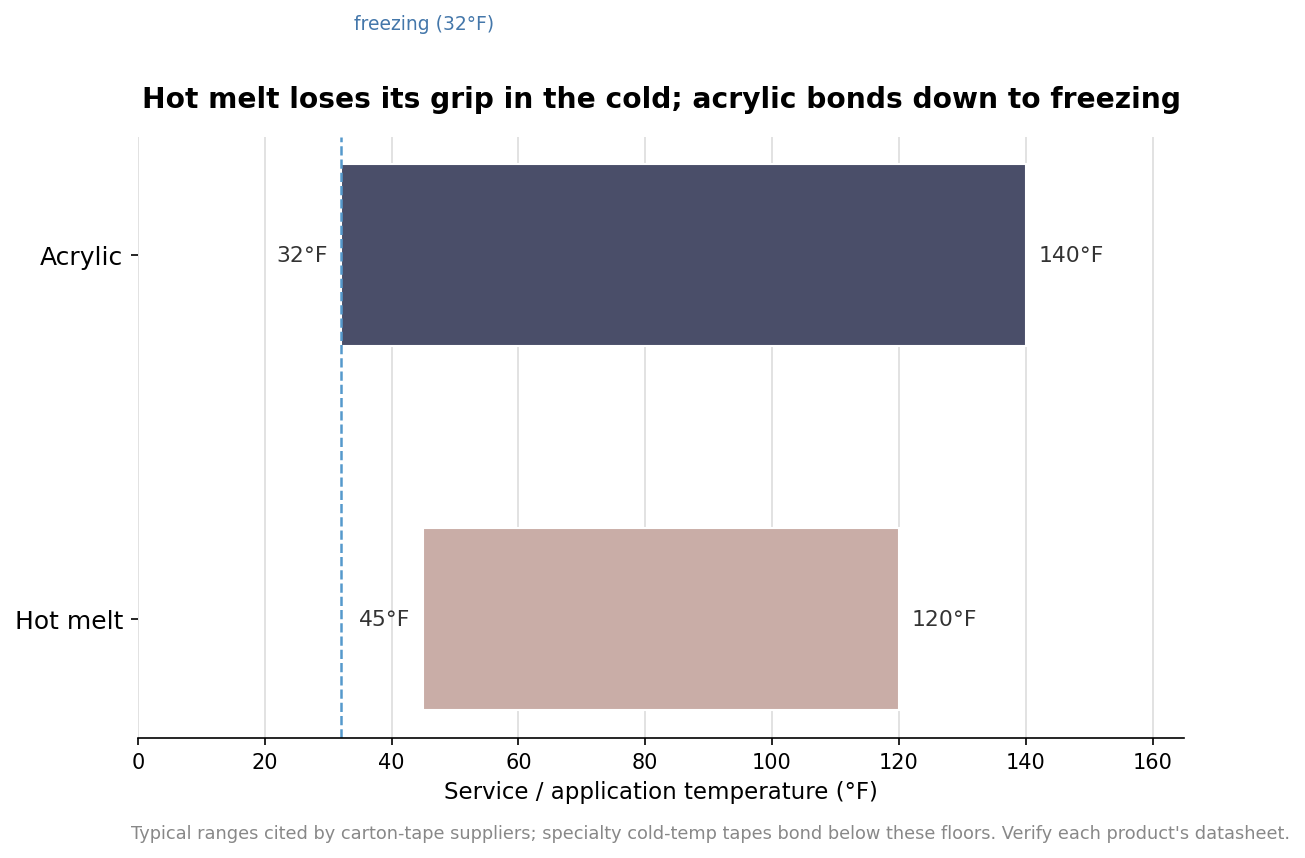
    Adhesive chemistry is temperature-sensitive, and this is where a lot of winter and cold-storage failures start. Hot melt adhesive gives an aggressive, fast grab at room temperature, but its bond weakens as the thermometer drops and it struggles below roughly 45°F. Acrylic adhesive bonds across a wider band, typically from around freezing at 32°F up to about 140°F, which is why it is the safer default for tape that will be applied on a cold dock or ride through an unheated trailer. If your cartons are sealed or stored below freezing, neither general-purpose option is enough; purpose-built cold-temperature tapes are formulated to bond at sub-freezing surfaces. The failure mode is sneaky because the tape looks stuck when it leaves the warm packing station and only peels once the box has spent hours in the cold, which means you rarely see the failure happen and only hear about it from the customer.

    Horizontal range chart comparing acrylic and hot melt carton tape service temperatures in Fahrenheit
    Acrylic bonds down to freezing; hot melt weakens below about 45°F.

    Mistake 3: Under-taping the seam on heavy cartons

    A single center strip is fine for a light box, but heavier cartons need more than one line of defense. The standard fix is the H-tape method: one strip down the center seam plus a strip across each end flap, so the finished tape pattern looks like an H when you view the box from the side. For wide or heavy cartons, a common recommendation is to move from 2-inch tape to 3-inch tape once the box exceeds about 16 inches wide, and to use one continuous strip rather than two narrow parallel strips, since a single wide seal spreads stress better and uses less labor. Skimping here is a false economy, because the reinforcement costs a few extra inches of tape and prevents the seam from being the weak point. The heavier the contents and the longer the transit, the more the H-pattern earns back its small extra cost in avoided damage claims.

    Mistake 4: Ignoring surface, pressure, and dwell time

    Pressure-sensitive tape bonds through three things working together: a clean surface, firm application pressure, and a little time to build adhesion. Recycled kraft cartons are dusty and porous, and dust is the enemy of a good bond, so tape laid lightly onto a dusty flap will look sealed and peel later. The remedy is mechanical, not chemical: run a tape gun or wipe-down applicator that presses the tape firmly onto the box, and give the adhesive a moment to key into the fibers before the carton is stacked. Humidity and moisture on the flap surface work against the bond in the same way dust does, so cartons pulled from a damp storage area deserve extra attention. This matters even more for the thinner, lower-cost tapes, which have less adhesive to compensate for a rushed application.

    Mistake 5: Buying on price per roll instead of price per yard

    The last mistake is an ordering one. Hand rolls commonly come in 55-yard and 110-yard lengths, while machine rolls run 1,000 to 2,000 yards, and a cheap-looking short roll can cost more per yard than a longer one. Two rolls that print the same at a glance can differ in length, backing thickness, and core size, so the only fair comparison is cost per usable yard for the thickness you actually need. When you are ordering custom printed tape, lock the specification before the price conversation: width, mil, adhesive type, roll length, and core size to fit your dispensers. Get those five numbers right and the branded tape does its real job, which is holding the box shut all the way to the doorstep while carrying your logo the whole way.

  • Hot Melt, Acrylic, or Rubber: Choosing the Right Packing Tape Adhesive

    Hot Melt, Acrylic, or Rubber: Choosing the Right Packing Tape Adhesive

    Two rolls of packing tape can look identical on the shelf, print the same logo, and cost within pennies of each other, then behave completely differently the moment a box hits a cold trailer or sits in a warehouse for six months. The difference is almost never the film you can see. It is the adhesive underneath it. Most buyers obsess over the carrier, BOPP versus paper, and treat the glue as an afterthought, which is exactly backwards. The adhesive decides whether your seal holds.

    Carton-sealing tape uses one of three adhesive chemistries: acrylic, hot melt, or natural rubber. Each has a temperature window where it performs and falls off outside it, so the environment your boxes travel through does most of the choosing for you.

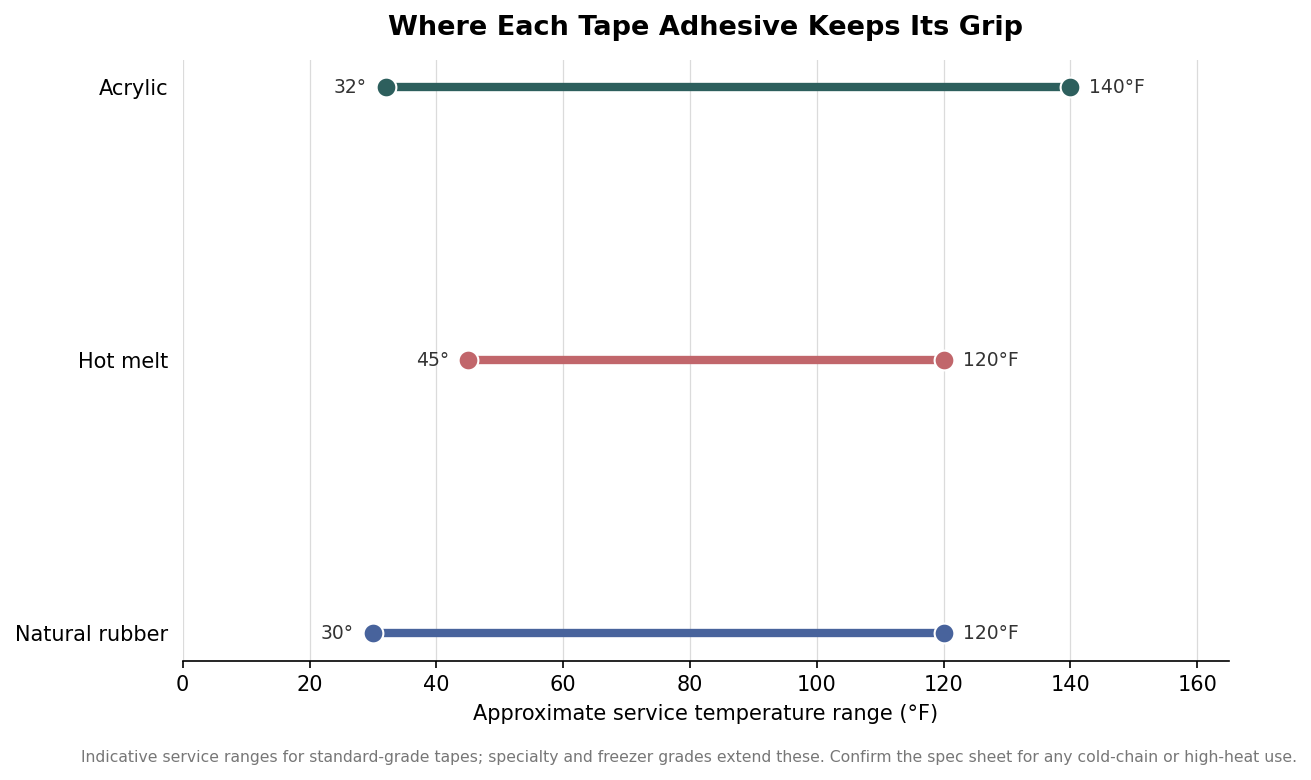
    Dumbbell chart of approximate service temperature ranges in Fahrenheit for acrylic, hot melt, and natural rubber packing tape adhesives
    The temperature envelope each adhesive works inside; standard grades shown, specialty tapes extend the range.

    Read that chart as the envelope each adhesive works inside. Acrylic holds its grip across the widest span, roughly 32°F to 140°F for standard grades, which is why it survives sun-baked trailers and refrigerated docks alike. Hot melt runs a narrower band, around 45°F to 120°F, and natural rubber grabs hardest in the cold but gives up the most at the high end. These are indicative ranges for everyday grades; freezer and high-heat specialty tapes push the limits further.

    Acrylic: the long-haul default

    Acrylic is the tape to reach for when time and sunlight are the enemy. Its defining trait is stability: it resists UV light, oxidation, humidity, and dust, and it does not yellow the way other adhesives do as they age. A box sealed with acrylic and stored for months looks and holds the same as the day it shipped, and its shelf life on the roll is the longest of the three. The catch is initial tack. Acrylic grabs more gently on contact and builds its bond over the hours after application, so it can feel underwhelming on the packing line even though it ends up perfectly secure. For long-term storage, UV-exposed shipments, and anything moving through swings between hot and cold, acrylic is the safe default, and it is usually the most economical of the three per roll.

    Hot melt: grip now, especially on recycled board

    Hot melt trades some longevity for immediate, aggressive holding power. Its shear value and tensile strength are higher than acrylic’s, and it tacks instantly, which is why high-throughput operations and automatic case sealers standardize on it. That quick grab matters most on difficult surfaces. Boxes with high recycled content have dustier, less uniform faces than virgin kraft, and hot melt bites into them where a gentler adhesive would lift at the corners. It also handles overstuffed and slightly irregular cartons well because it stretches under stress without releasing. The downside is aging: hot melt can yellow over time and has a shorter shelf life, and its narrower temperature window means it is not the tape for a cold-chain shipment or a pallet parked in the sun for a season. For fast-moving fulfillment on recycled boxes, though, nothing seals more confidently out of the gate.

    Natural rubber: maximum grab for the hard cases

    Natural rubber is the specialist you call when a surface refuses to cooperate. It offers the most aggressive initial tack of the three and performs well at low temperatures, so it clings to cold, dusty, or heavily recycled surfaces that defeat other adhesives. That grabbing power comes at a real cost in durability: natural rubber has the poorest resistance to UV, heat, and aging, tends to yellow, and can carry a noticeable odor. It is also frequently the priciest option. You would not spec it for routine e-commerce cartons, but for a specific problem, sealing recovered or contaminated boxes, or a job where nothing else will stay stuck, it earns its place. Treat it as a tool for edge cases rather than a daily driver.

    Reading the trade-off

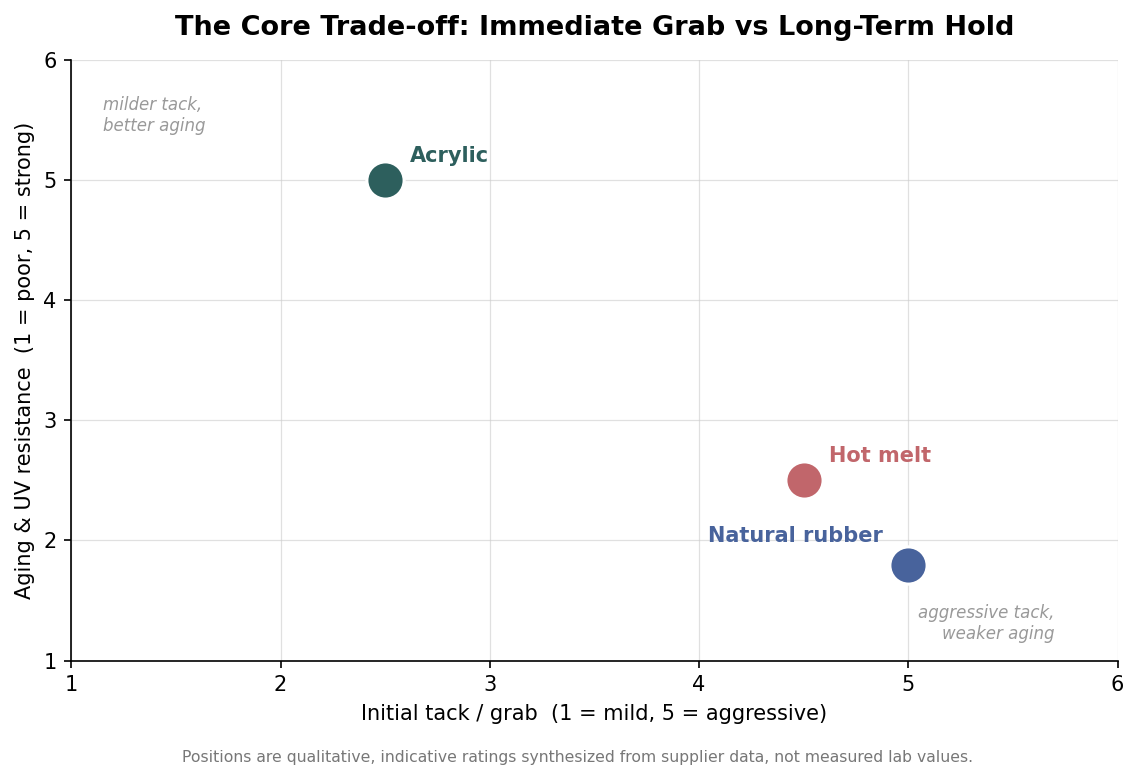
    Line the three up and a clear pattern emerges. The adhesives that grab hardest on contact are the ones that age worst, and the one that ages best grabs most gently. There is no chemistry that wins on both, so choosing well means deciding which failure you can least afford: a box that lifts at the seam on the line, or a box that yellows and loosens after a season in storage.

    Scatter plot mapping initial tack against aging and UV resistance for acrylic, hot melt, and natural rubber tape adhesives
    The core trade-off: adhesives that grab hardest on contact tend to age the worst.

    The map makes the tension concrete. Acrylic sits high on longevity and low on grab; natural rubber sits at the opposite corner; hot melt lands in between, closer to the aggressive end. Where your operation belongs on that map depends entirely on what happens to the box after it leaves you. A gift that ships today and is opened Thursday never tests aging resistance. A spare part that sits in a bin for two years never benefits from quick tack. Match the adhesive to the box’s actual life, not to which spec sheet sounds strongest.

    How to actually choose

    Start with two facts about your shipments: the temperature range they pass through, and how long the seal has to survive. Cold, dusty, or recycled surfaces and immediate handling point toward hot melt, or natural rubber for the genuinely stubborn cases. Long storage, temperature swings, or sun exposure point toward acrylic. Then confirm the carrier and thickness separately, since a good adhesive on an underweight film still fails; standard carton tapes commonly run around 1.6 to 2.0 mil, with heavier grades for demanding loads. If you print a custom design on the tape, remember that the print sits on the film and does not change the adhesive underneath, so you get branding and the right chemistry at the same time rather than trading one for the other. When a shipment is high-value or headed somewhere extreme, order a roll of your leading candidate and test it on your real boxes in your real conditions before committing to a full run. The numbers here are solid starting points, but your cartons and your climate are the final word.

  • A 3PL’s Guide to Packing Tape Margins and Order Economics — Custom Packing Tape

    Call or Text us: (929) 605-4397

    HomeBlog › A 3PL's Guide to Packing Tape Margins and Order Economics

    3PL & Warehousing

    A 3PL's Guide to Packing Tape Margins and Order Economics

    06/30/2026

    A 3PL runs enormous volumes of tape through its own operation and rarely thinks of that tape as anything other than a consumable line item. That framing misses an opportunity sitting in plain sight: every carton a 3PL seals on behalf of a client is a chance to reinforce that client’s brand, or to quietly reinforce the 3PL’s own, at a cost that barely moves the needle on fulfillment economics.

    Here’s how to think about the numbers, and where the return actually shows up.

    The per-roll cost curve

    Custom tape pricing drops meaningfully as order size increases, mostly because plate setup and press changeover costs get spread across more rolls. A 3PL ordering at case-lot volumes is already positioned to hit the lower end of that curve, especially if tape is folded into a recurring supply order rather than purchased reactively.

    Order sizeTypical per-roll price range*
    12 rolls (MOQ)Highest tier
    100 rollsUpper-mid tier
    500 rollsLower-mid tier
    1,000+ rollsLowest tier

    *Estimates only, illustrative of typical volume pricing — request a quote for your exact specs and roll width.

    Two ways to run the branding

    There are two models worth separating. The first is white-label: printing each client’s logo on the tape used for their outbound shipments, effectively offering branded packaging as a value-added service. This works well for 3PLs serving DTC and subscription-box clients who already care about unboxing presentation and will pay a modest markup for it. The second is house-branded: printing the 3PL’s own logo on tape used across all clients, turning every outbound carton into a quiet advertisement for the fulfillment operation itself, visible to the client’s own customers and anyone else who handles the box in transit.

    Many 3PLs run both — house-branded tape as the default, with white-label runs offered as a premium add-on for clients who request it.

    Where the margin actually shows up

    If you’re offering white-label branded tape as a service line, the markup on the tape itself is only part of the return. The larger effect is retention: a client who has invested in custom packaging through your facility has a switching cost baked in if they ever consider moving to a competitor. If you’re running house-branded tape, the return isn’t a markup at all — it’s marketing spend disguised as a packaging consumable, priced at a few cents more per carton than unbranded tape would cost.

    Key takeawayPer-roll cost drops by roughly 30–40% between MOQ and 1,000+ roll orders, and branded tape pays for itself either as a billable client service or as ultra-low-cost marketing on every outbound carton.

    Planning Your Next Order

    Start by separating your two use cases: your own house branding, which should run at your highest achievable volume tier for the best unit economics, and any client-specific white-label runs, which can be ordered in smaller batches and priced into your service fee. Forecasting both against your monthly outbound carton count will tell you which volume tier you should be ordering at — most 3PLs underestimate this and end up buying at MOQ pricing when their actual usage supports a much better rate.

    Ready to price out your volume tier? Get a custom quote and we’ll model pricing against your monthly carton count. Read more about how we work, or browse more guides.

    More posts

  • How to Order Custom Packing Tape: A Step-by-Step Checklist — Custom Packing Tape

    Call or Text us: (929) 605-4397

    HomeBlog › How to Order Custom Packing Tape: A Step-by-Step Checklist

    Ordering

    How to Order Custom Packing Tape: A Step-by-Step Checklist

    06/01/2026

    Ordering custom tape for the first time involves fewer decisions than most people expect, but getting them in the right order saves a round of back-and-forth. Here’s the process from raw artwork to a delivered case, laid out as a checklist you can work through in one sitting.

    Most first-time orders go from inquiry to delivered product in about two weeks once artwork is approved — the steps below are what fills that window.

    1. Prep your artwork file

    Vector files (AI, EPS, or high-resolution PDF) print cleanest, since flexo printing reproduces sharp lines and solid fills better than it reproduces gradients or fine detail. If you only have a logo as a PNG or JPG, send it anyway — our design team can usually vectorize a clean logo at no extra charge, though very detailed or photographic artwork may need simplification first. Include your Pantone (PMS) color reference if you have one; it removes guesswork from the print match.

    2. Decide roll width and quantity

    48mm is the standard width and fits any standard tape gun and most cartons in one pass. Quantity starts at our MOQ of 12 rolls — enough for a small operation to get started, or a single retail launch. If you’re not sure how many rolls you’ll need, work backward from your monthly shipment volume: most cartons use 15–20 feet of tape per seal, and a 100-meter roll covers roughly 16–20 boxes.

    3. Choose your color and backing

    Pick a backing — clear, tan/kraft, white, or a custom Pantone base — and a print color count. Clear with black print is the most common, most economical combination and works on any box color. If you’re not sure yet, it’s fine to note “not sure yet” on your quote request; we’ll walk through the options based on your box and brand.

    4. Review and approve your mockup

    Once your artwork and specs are in, we turn around a digital mockup in 24–48 hours showing your logo printed to scale on the tape roll and repeated down a sample carton seam. This is the point to check spacing, color accuracy, and legibility at actual size — logos that look fine at full screen size sometimes need simplification to stay legible on a 2-inch strip. Revisions at this stage are free and typically turn around within a day.

    5. Production and delivery

    Once the mockup is approved, production begins. Standard lead time is about two weeks from approval to delivery, covering plate setup, the print run, and shipping. Larger orders or multiple SKUs (say, a different print for two brands or two box sizes) may run slightly longer — we’ll give you a firm date at approval, not an estimate.

    StepWhat happensTypical timing
    Quote & artwork submissionSend logo file, Pantone reference, width and quantitySame day
    MockupDigital proof of your logo on the tape roll24–48 hours
    Approval & revisionsReview spacing, color, legibility1–2 days if changes needed
    Production & shippingPlate setup, print run, delivery~2 weeks from approval
    Key takeawayA first-time order runs from quote to delivery in about two weeks once artwork is approved — the only variable you control is how quickly you review the mockup.

    Starting Your Order

    The checklist above covers every decision you’ll actually be asked to make. Most of it can be answered in a single quote request: your logo file, your preferred roll width (48mm unless you know otherwise), your quantity, and your color preference. Everything else — Pantone matching, layout, mockup revisions — happens after that first message, with our team guiding the specifics.

    Ready to start? Get a custom quote and we’ll have a mockup back to you in 24–48 hours. Read more about how we work, or browse more guides.

    More posts

  • Does Custom Packing Tape Actually Hold Up? A Durability Comparison — Custom Packing Tape

    Call or Text us: (929) 605-4397

    HomeBlog › Does Custom Packing Tape Actually Hold Up? A Durability Comparison

    Durability

    Does Custom Packing Tape Actually Hold Up? A Durability Comparison

    05/10/2026

    The most common objection to ordering custom tape isn’t cost or lead time — it’s a lingering worry that printed tape somehow performs worse than the unbranded tape a warehouse already trusts. It’s a fair question, and the honest answer is that print has nothing to do with it. Performance comes down to film thickness, adhesive formulation, and whether the tape is built for the weight it’s sealing.

    Here’s what actually determines whether a roll of tape holds up, and where cheap tape tends to fail.

    Tensile strength: what the number actually means

    Tensile strength measures how much pulling force a strip of tape resists before it stretches and snaps. For carton sealing, this matters most when a box is dropped, dragged, or shifts under other freight in transit — the tape needs to hold the flaps together under sudden stress, not just static weight. A standard 2.0–2.5 mil BOPP tape is rated for the large majority of standard shipping cartons under about 40 lbs. Beyond that, or for boxes handled roughly through a fulfillment or freight network, a heavier film or reinforced tape gives you a real margin of safety instead of a seal that’s barely adequate.

    Adhesion in heat and cold

    Adhesive performance isn’t constant across temperature. Acrylic adhesives (the standard for BOPP tape) hold a consistent tack across a wide range and are the more temperature-stable choice for tape that might sit in a hot delivery truck or a cold warehouse dock before it’s ever applied. Hot-melt adhesives grab faster and can be more economical, but they can soften in high heat and stiffen in cold, which is worth knowing if your cartons travel through extreme conditions or sit in an unclimate-controlled storage unit for weeks.

    Standard BOPP vs. reinforced tape

    For most e-commerce and retail shipments, standard BOPP is more than sufficient. For heavier cartons — equipment, dense retail goods, palletized freight edges, or anything that gets handled multiple times before final delivery — fiberglass-reinforced tape (sometimes called filament tape) adds directional strength that plain film tape doesn’t have.

    FactorStandard BOPPReinforced Tape
    Tensile strengthModerate — suited to standard cartonsHigh — fiberglass filament adds directional strength
    Best carton weightUp to ~40 lbs40–70+ lbs, dense or awkward loads
    Typical failure mode (if under-specced)Adhesive lift at corners, seam splitting under stressRare under normal use — failure usually traces to a damaged carton, not the tape

    What actually fails on cheap tape

    When a roll of tape lets a box down, it’s almost always one of two failures: adhesive lift, where the tape peels back from a corner or edge because the adhesive wasn’t rated for the box’s weight or the ambient temperature, or seam splitting, where the film itself tears under stress because it was too thin for the job. Both are avoidable by matching film thickness and adhesive type to the carton weight up front, rather than defaulting to whatever tape is cheapest per roll.

    Print quality has no bearing on either failure mode. A custom-printed roll built to the same 2.0–2.5 mil BOPP spec as an unbranded roll performs identically — the only difference is what’s printed on it.

    Key takeawayTape failure is almost always a spec mismatch, not a print problem — match film thickness and adhesive type to your carton weight and a custom roll performs exactly like an unbranded one.

    Specifying the Right Tape for Your Cartons

    Before your next order, take stock of your heaviest regular shipment, not your average one. If your typical carton is light but you occasionally ship something dense, it’s worth running a reinforced roll for those orders rather than hoping standard tape holds. Getting this right once at order time means you’re not troubleshooting damaged shipments later.

    Not sure which spec fits your cartons? Get a custom quote and we’ll recommend a film and adhesive based on your typical box weight. Read more about how we work, or browse more guides.

    More posts

  • A Mover’s Guide to Branded Packing Tape — Custom Packing Tape

    Call or Text us: (929) 605-4397

    HomeBlog › A Mover's Guide to Branded Packing Tape

    Moving & Storage

    A Mover's Guide to Branded Packing Tape

    04/19/2026

    A residential move generates more brand impressions per job than almost any other service business gets in a month. Every carton the crew packs, seals, and carries through a client’s home and into the truck is a small, repeated advertisement — if the tape is branded. If it’s a roll of clear tape from a warehouse club, that impression is wasted.

    Moving and storage companies are one of the highest-volume users of packing tape in any industry, which makes it one of the cheapest branding upgrades available to the business.

    Why tape matters more for movers than most businesses

    Clients judge a moving company on things they can actually see: how the crew handles their belongings, how organized the truck looks, and how the boxes look once they’re stacked in a new living room. A carton sealed with a clean, branded strip of tape signals the same professionalism as a uniformed crew or a clearly labeled truck. It costs a fraction of either and shows up on every single box.

    It also matters after the move is over. Boxes often sit in a garage or storage unit for weeks before they’re unpacked, and during that time, your company name is the only thing on them. Neighbors see it during a move-in. Anyone helping unpack sees it. That’s free, ongoing visibility a plain box or generic tape never delivers.

    The roll math for an average move

    A typical two- or three-bedroom residential move runs somewhere between 40 and 70 boxes. At roughly 15–20 feet of tape per carton for a standard cross-seal (top seam plus flap reinforcement), one 100-meter roll seals about 16–20 boxes. That puts a single average move at 3–4 rolls, and a busier crew running two or three jobs a week will burn through a case of 36 rolls in under a month.

    That volume matters for planning: it means branded tape isn’t a specialty item you order once a year, it’s a recurring supply cost you can fold into the same ordering rhythm as boxes, blankets, and shrink wrap.

    Durability for real moving conditions

    Moving tape has to hold under different stress than a shipped parcel — boxes get stacked, jostled in a truck, carried up stairs at odd angles, and sometimes stored for weeks in a garage with temperature swings. A standard 2.0–2.5 mil BOPP tape handles the large majority of household cartons without issue. For heavier loads — book boxes, dish packs, anything packed to the weight limit — a reinforced tape with a stronger adhesive tack holds a tighter seal over time and resists the corner-lifting that cheaper tape shows after a few days in transit or storage.

    Move typeRecommended tapeWhy
    Standard household boxesStandard BOPP, 2.0–2.5 milReliable seal at normal box weights, most economical
    Dish packs, books, heavy itemsCustom logo reinforced tapeHigher tack and tensile strength for weight and repeated handling
    Long-term storage cartonsStandard or reinforced BOPPHolds seal through temperature swings over weeks or months
    Key takeawayAn average residential move uses 3–4 rolls of tape, which means branded tape functions as a recurring, low-cost advertising channel that shows up on every job, not a one-time purchase.

    Making It Part of Every Job

    The moving companies that get the most out of branded tape treat it the same way they treat branded uniforms or a labeled truck — as standard equipment, not an optional upgrade. Once it’s built into your packing supply order, every crew member seals every box the same way, and every client sees your name on their belongings from the first box packed to the last one unpacked.

    Ready to put your logo on your next case of tape? Get a custom quote and we’ll send free mockups in 24–48 hours. Read more about how we work, or browse more guides.

    More posts

  • BOPP vs. Kraft Paper Tape: Which Packing Tape Should You Use? — Custom Packing Tape

    Call or Text us: (929) 605-4397

    HomeBlog › BOPP vs. Kraft Paper Tape: Which Packing Tape Should You Use?

    Buyer Guides

    BOPP vs. Kraft Paper Tape: Which Packing Tape Should You Use?

    03/29/2026

    Nearly every custom tape order comes down to one fork in the road before color or logo placement is even discussed: BOPP film or kraft paper. They seal a box equally well. What they signal to the person opening it is different, and that difference should drive the decision more than habit.

    Here’s what actually separates the two, and where each one earns its place.

    BOPP: the glossy, high-tack default

    BOPP (biaxially-oriented polypropylene) is a clear plastic film tape with an acrylic adhesive. It’s the tape most people picture when they think of packing tape — glossy, translucent or tinted, and strong enough to hold on most carton stocks in a single pass. It’s also the most economical option to print, which keeps per-roll pricing lower at every volume tier.

    The tradeoff is aesthetic and environmental: it’s a petroleum-based film, and it doesn’t carry the same sustainability signal that a paper-based tape does, even though the roll itself is thin and lightweight relative to the box it’s sealing.

    Kraft paper tape: the natural, eco-forward option

    Kraft paper tape uses a paper backing, typically with a water-activated or pressure-sensitive adhesive. It has a matte, natural-fiber look that pairs directly with kraft boxes and mailers, and for brands leaning into a sustainable or artisanal identity, it does more visual work than a printed logo alone. Application is slightly different — water-activated kraft tape needs a moistening step or a dispenser built for it, while pressure-sensitive kraft tape applies like standard tape but with a firmer press to fully set the adhesive.

    Side-by-side comparison

    FactorBOPP TapeKraft Paper Tape
    LookGlossy, clear or tinted filmMatte, natural paper fiber
    CostLower per roll at every tierModerate premium over BOPP
    Sustainability signalNeutral to low — plastic filmStrong — reads as recyclable, natural
    Adhesion / applicationPressure-sensitive, applies with any standard tape gunPressure-sensitive or water-activated; firmer press or moistening needed
    Best forHigh-volume DTC, fulfillment centers, general shippingSustainability-forward brands, kraft box packaging lines
    Key takeawayChoose BOPP when cost and shipping volume matter most; choose kraft paper tape when the tape itself needs to reinforce a natural, sustainability-forward brand story.

    Making the Call for Your Shipments

    If your boxes are already kraft brown and your brand talks about sustainability anywhere in your marketing, kraft paper tape closes the loop — it looks intentional rather than bolted on. If you’re shipping high volume, need the lowest per-unit cost, or your box color varies, BOPP is the safer, more economical default, and clear BOPP works on any box color without clashing.

    Some brands run both: kraft paper on retail-facing shipments and BOPP on bulk or wholesale pallets where cost matters more than presentation. There’s no rule against splitting a print run once you know your volumes.

    Not sure which fits your product? Get a custom quote and we’ll recommend a material based on your box, budget, and brand. Read more about how we work, or browse more guides.

    More posts

  • Custom Packing Tape for E-commerce Brands: Sizes, Colors, and Print Setup — Custom Packing Tape

    Call or Text us: (929) 605-4397

    HomeBlog › Custom Packing Tape for E-commerce Brands: Sizes, Colors, and Print Setup

    E-commerce

    Custom Packing Tape for E-commerce Brands: Sizes, Colors, and Print Setup

    03/15/2026

    The box arrives before the product does. For a direct-to-consumer brand, the tape running down the center seam is often the first physical brand touchpoint a customer sees — ahead of the box itself, ahead of any insert, ahead of the product. Plain tape on a branded box reads as an afterthought. Printed tape reads as intentional.

    Ordering your first run is straightforward once you’ve made four decisions: roll width, print color count, backing color, and how much of the box you want the tape to cover. Here’s how to think through each one.

    Roll width: 48mm is the default for a reason

    Standard shipping cartons are built for a 48mm (about 2-inch) roll. It seals a typical carton seam in a single pass, fits every standard tape gun on a fulfillment line, and is the width nearly every 3PL and packer already expects. Unless you have an unusual box size or a manual-packing setup where a narrower or wider roll makes sense, start at 48mm x 100m — it’s also the width with the fastest production turnaround because it’s what most print runs are already set up for.

    Print color count: what you gain at each step

    Your logo doesn’t need four colors to be recognizable on a tape roll — in fact, most of the strongest custom tape designs use one or two. Each added color increases plate setup and run complexity, which shows up in cost and lead time. Here’s the general tradeoff:

    Print setupSetup complexityTypical cost impactVisual impact
    1-colorLow — single plateBaselineClean, bold, reads well repeated down a seam
    2-colorModerate — two plates alignedSmall increase over 1-colorAdds contrast — logo plus a tagline or wordmark
    3-colorHigher — tighter registration toleranceNoticeable increase, still order-friendly at MOQFull-color logo detail, best for brands with a signature palette

    A single dark color on a light backing is usually the highest-impact, lowest-cost option, since the repeating pattern down the seam does most of the branding work on its own. Save the third color for logos where the extra hue is doing real identification work, not just decoration.

    Clear vs. colored backing

    Clear BOPP tape with black or dark print is the most common choice for e-commerce — it looks premium against any box color and photographs cleanly for unboxing content. A tan or kraft backing leans into a natural, sustainability-forward look and pairs well with kraft mailers. White backing gives the highest print contrast and is the best base for full-color or lighter-colored logos that would wash out on clear film.

    How much of the box should be taped?

    Most DTC brands print tape long enough to cover the top seam plus both side flaps of a standard carton — roughly three strips per box. That’s enough for the logo to repeat two or three times per strip on a 48mm roll, so the branding is visible no matter which angle the box lands in a photo or on a doorstep. Taping only the center seam is more economical per box but limits visibility to a single strip; taping all edges is common for fragile or high-value shipments where the extra seal also functions as tamper evidence.

    Matching your brand colors

    Flexo printing on tape reproduces spot colors well, and matching to a Pantone (PMS) number is the standard way to keep your tape consistent with your box, mailer, and website. Send your Pantone reference with your order, not just a hex code or a screenshot — screen colors and printed colors don’t always agree, and a PMS number removes the guesswork. If you don’t have a Pantone on file yet, our design team can match one from your existing packaging or logo file during mockup.

    Key takeawayStart with a 48mm roll, one or two print colors, and a Pantone-matched color reference — that combination covers the large majority of e-commerce orders without adding cost or lead time.

    Getting Your Order Right the First Time

    The decisions above aren’t really about the tape — they’re about making sure the unboxing moment matches the rest of your brand. A roll that’s the wrong width slows down your packing line; a print that’s off-Pantone looks like a mismatch next to your box. Getting the specs right at order time means every carton that leaves your warehouse looks like it was built by the same brand, because it was.

    Ready to spec out your first run? Get a custom quote and we’ll send free mockups in 24–48 hours. Read more about how we work, or browse more guides.

    More posts