Two numbers decide whether a sealed box survives the trip: how thick the tape film is, measured in mils, and how wide the roll is, measured in inches. Everything else on a tape spec sheet, from the printed artwork to the adhesive chemistry, sits on top of those two choices. Get them wrong and the seam pops in a trailer or on a doorstep. Get them right and a plain two-strip seal holds through a full parcel network. This walkthrough shows how to pick both figures against the boxes you actually ship, then how to write the spec so a supplier quotes the right product the first time.
Start with the packed weight, not the box
Tape thickness is the single spec most buyers underestimate. A mil is one one-thousandth of an inch, and carton-sealing tape generally runs from about 1.6 mil at the economy end to 3 mil and up for the heaviest loads. The film thickness matters because it carries the tension when a loaded box flexes; a thin film stretches and peels at the corners, while a thicker film resists that pull. The deciding input is the packed weight of the box, not its footprint. A small carton full of hardware can outweigh a large carton of foam, and it needs the sturdier tape.
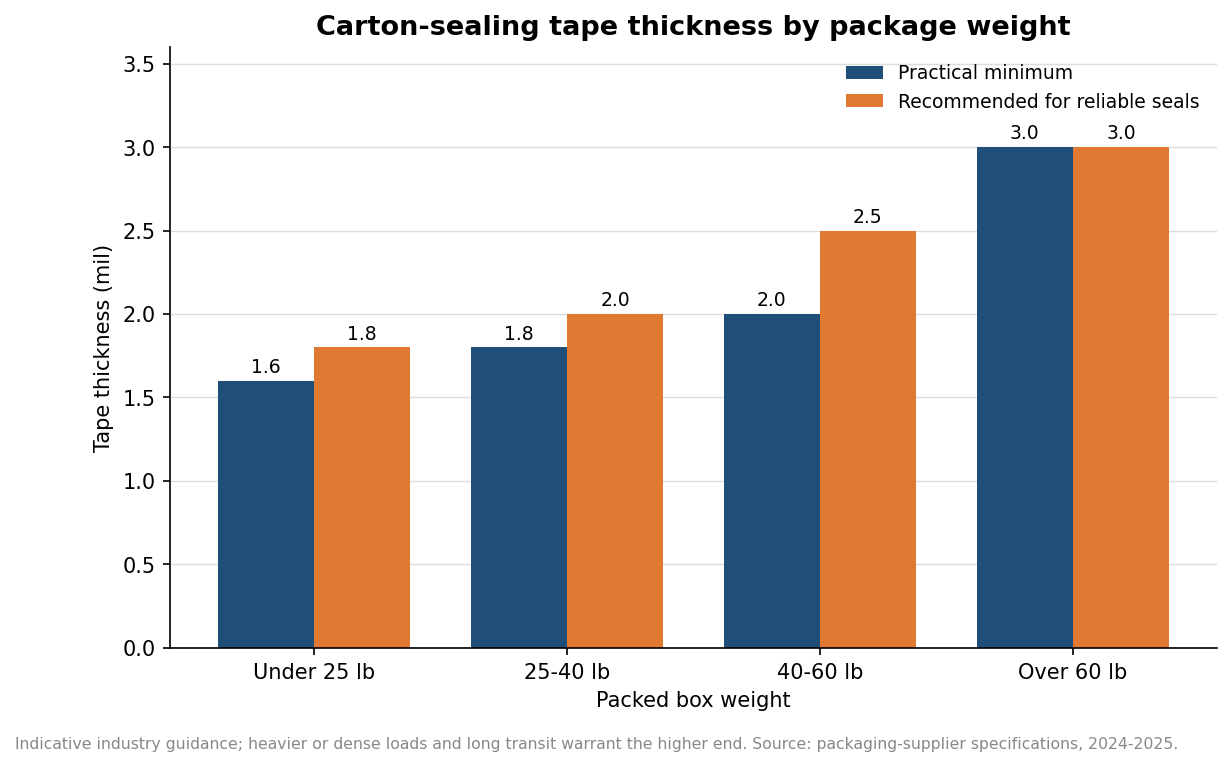
As a working guide, boxes under roughly 25 pounds seal reliably with 1.6 to 1.8 mil tape, the range most light parcel and retail shipments fall into. Once a packed box passes 25 pounds you want 2.0 mil or a little more, and dense or awkward loads above 40 pounds are better served by 2.5 mil. Past about 60 pounds, 3 mil is the sensible floor, and many shippers pair it with reinforced or water-activated tape rather than standard film. These are indicative bands, not hard cutoffs: long transit legs, humid warehouses, and boxes that get restacked several times all push you toward the higher end of each range.
Width: when two inches is plenty and when it isn’t
Roll width is the second lever, and here the common sizes are genuinely standard. Two inches, which suppliers often list as 48 millimeters, is the default for the majority of parcels, and it seals the center seam of most small and medium cartons in a single pass. Three inches, listed as 72 millimeters, covers a wider span of the flap gap and grips more surface, which matters on heavy boxes, on cartons whose flaps do not meet cleanly, and anywhere you are relying on a single strip rather than several. The wider tape costs more per foot but can let you seal a box in fewer passes, so the real comparison is total tape laid down, not the price of one roll.
Most shippers do not need to choose one width forever. A practical setup keeps 2 inch tape for everyday parcels and a 3 inch roll for the heavy or oversized cartons that show up less often. If you are standardizing on a single width to simplify buying, 2 inch handles the broadest range of typical e-commerce and retail boxes, and you compensate on heavier cartons by adding strips rather than switching rolls.
Why thicker tape costs more, and where the money goes
Thickness is not free, and it helps to see why before you default to the heaviest option. Most of a tape’s thickness is the backing film plus the adhesive coat, and both scale roughly with the mil rating. Moving from 1.6 mil to 3 mil nearly doubles the material laid down per unit of length, and the per-roll price tends to track that. Buying more thickness than the box needs quietly inflates your cost of goods on every shipment, while buying too little shows up as damage claims and reships that cost far more than the tape ever saved.
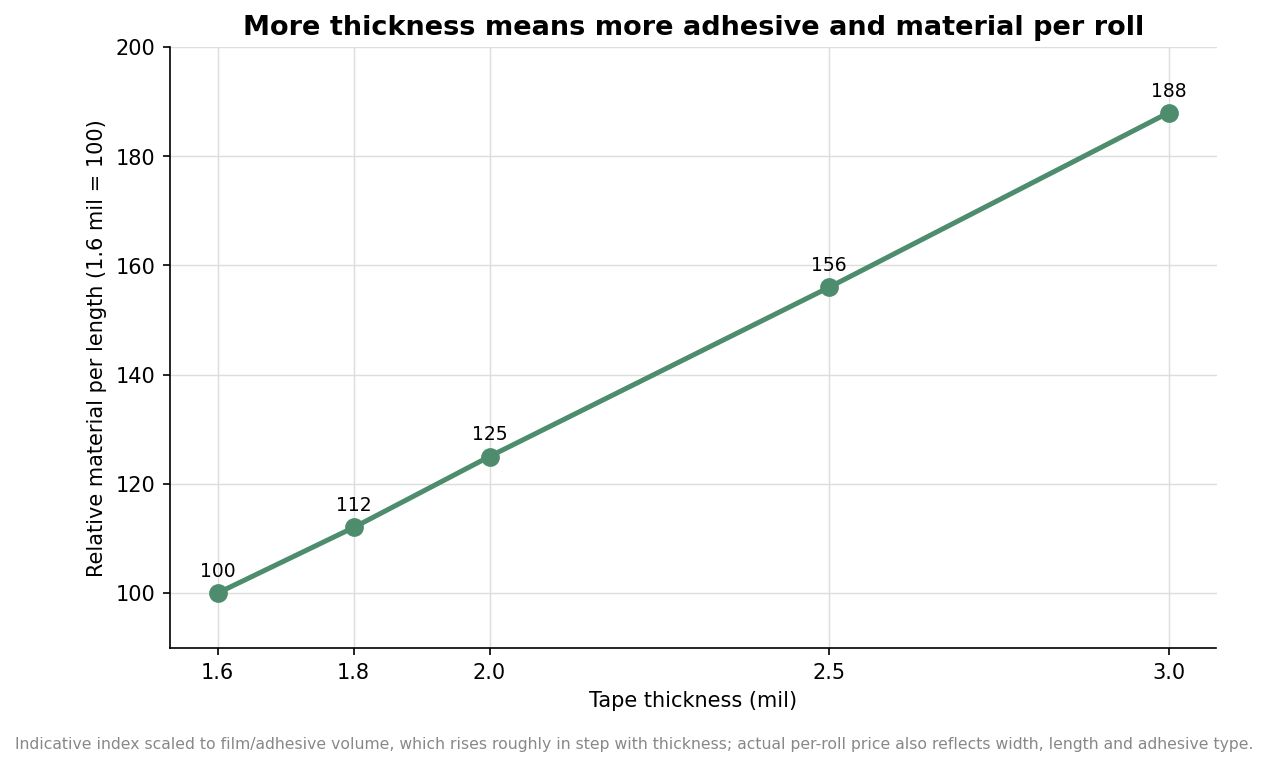
The index above is indicative rather than a price quote: actual cost also swings with roll width, roll length, adhesive type, and print coverage. The point is directional. Matching thickness to weight, rather than over-speccing to feel safe, is where a high-volume shipper finds real savings without trading away seal reliability.
Adhesive and temperature interact with thickness
Thickness sets the ceiling on strength, but the adhesive decides whether you reach it. The two workhorse chemistries are acrylic, which is water or solvent based and holds up well across a wide temperature and humidity range, and hot melt, which grabs fast and delivers a firmer initial bond but can soften in real heat. A 2 mil hot melt tape and a 2 mil acrylic tape are not interchangeable in a hot trailer or a freezer program, so the application environment belongs on the spec sheet next to the thickness. Cold surfaces below roughly 45 degrees Fahrenheit are the classic failure point, because adhesive that cannot flow into the cardboard fibers never really sticks. If your boxes are taped in an unheated space or shipped cold, say so up front and let the supplier match a low-temperature adhesive rather than discovering the gap after a batch fails.
Surface matters too. Recycled and heavily printed corrugate can be dusty or coated, both of which fight adhesion, and a slightly thicker tape with a more aggressive adhesive buys back some of that lost grip. None of this replaces good technique: pressing the tape down along its full length, and using an H-pattern that seals the center seam and both end seams on heavier boxes, does more for reliability than one extra half-mil of film.
Write the spec so the quote comes back right
When you hand a supplier a request, five lines remove almost all of the back-and-forth. State the thickness in mils tied to your typical packed weight, the width in inches or millimeters, the roll length you want, the adhesive type and any temperature exposure, and the print requirement if the tape is branded. A line such as “2.5 mil, 3 inch by 110 yard, acrylic, one-color print, boxes average 45 pounds and ship year round in unconditioned trucks” tells a quoting team everything they need and produces a comparable price instead of a guess.
Roll length is worth a deliberate choice rather than an afterthought. Hand rolls commonly run in the range of 55 to 110 yards, while machine rolls for tape guns and case sealers run far longer, often several hundred yards, to cut changeover time on a line. Longer rolls lower the price per foot and reduce downtime, but only pay off if your volume turns them over before the adhesive ages. Buy the length that matches your throughput, pair it with the thickness your boxes actually demand, and the seam stops being something you think about.
Leave a Reply